Willingness comes first.
Registration expresses interest in exploring the model. No payment is requested today.

Our community. Our responsibility.
YTEC is exploring a community-wide way to fund Torah education—sharing the responsibility more broadly while our yeshivot remain independent.
Register your willingnessA different way forward
Torah education sustains our whole community.
Its future is ours to carry together.
Registration expresses interest in exploring the model. No payment is requested today.
Their own chinuch, admissions, faculty, leadership and daily operations.
YTEC can work alongside other tuition initiatives toward a sustainable future.
A different way to carry it
01 / THE PRESSURE
The tuition burden is felt by families, schools and donors. The cost of sustaining our yeshivot reaches far beyond the classroom.
Torah education sustains the whole community. Its financial future should be a shared responsibility.


02 / THE APPROACH
Broaden participation across the community and combine it with philanthropy, government support and other available funding.
03 / THE FUTURE WE’RE WORKING TOWARD
The goal: lasting relief for families and a more stable foundation for our yeshivot, with responsibility shared across the community.

Potential relief from tuition pressure, with more room for family and community needs.
A stronger, more predictable funding base while schools retain their independence.
Broader participation in sustaining the Torah education our next generation depends on.
A shared future begins with willingness.
Final funding and operating details still need to be worked through responsibly. No payment is requested today.One family. A different possibility.
An illustration for two parents
and four children.
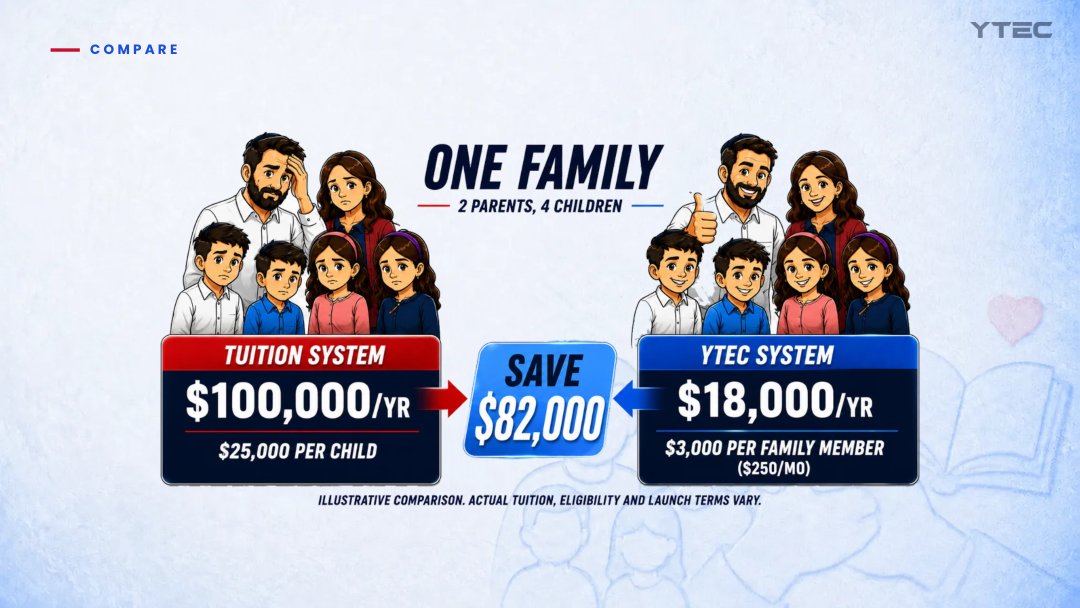
Illustrative working model. Figures, eligibility and final terms may change as the model is developed.
Explore how the plan worksTake the next step
Register your willingness to seriously explore a different way of funding Torah education.
One community. A shared future.
Register your willingnessNo payment is requested today.Your questions, answered
Registration comes first. Final funding, governance and operating details are still being developed.
YTEC—the Yeshiva Tuition Elimination Commission—was created to eliminate yeshiva tuition by making the cost of Sephardic education a shared community responsibility. Our goal is to reduce the financial pressure on families, strengthen our yeshivot, and preserve quality Torah education for future generations.
YTEC proposes broadening the responsibility for yeshiva education across the community and combining that participation with philanthropy, government support and other available funding. Right now, registration records willingness to participate. The final financial model, governance, safeguards and operating structure still need to be worked through responsibly.
Every member of the Sephardic community should sign up—not only parents currently paying tuition. Parents, grandparents, young adults, newly married couples, and future parents all benefit from a strong yeshiva system and are part of the shared community solution.
YTEC is being built to fund Torah education. The final arrangements for approved school budgets, use of funds, oversight and safeguards should be shaped with the schools and the community’s rabbinic, professional and lay leadership. Registration does not commit a school to a final agreement.
No payment is requested when you register. You are registering your willingness to participate and to seriously explore a different way of funding Torah education. Registration is not a request for payment today.
Only the basic contact and household information requested on the registration form is needed. No income statements, pay stubs, bills, hardship documents, or payment information are required to register. Registration is simply how community members show their commitment and help YTEC reach the participation needed to launch.
The current household form asks for the person registering, their spouse and unmarried children. Final participation and household rules need to be clarified as the model is developed. Registration records willingness to participate; it does not begin payments.
The working model illustrates an annual contribution of $3,000 per participating person. In the comparison shown on the homepage, two parents and four children total six people and $18,000 per year. These are illustrative figures; the financial model and final terms remain to be refined.
The working household model includes unmarried children in their parents’ household, with married children registering separately. Final participation rules, including the treatment of adult children, need to be clarified as the structure is developed.
No payments are being requested with registration. Funding, governance, legal and operational questions must be addressed responsibly before the system becomes operational. The final launch conditions and payment arrangements remain to be established.
The working model illustrates $3,000 per person annually, equivalent to $250 per month. Final payment schedules, authorization and arrangements remain to be developed. No payment is requested today.
Reducing the burden on families and protecting their dignity are central to YTEC’s purpose. The final structure will need to address affordability, assistance and safeguards responsibly with the appropriate professionals and community leadership.
The final tax wording and supporting documentation need to be confirmed through the appropriate legal and professional review. Registration does not ask you to make a payment today.
The Torah and halachic framing of YTEC, including questions about maaser, should be reviewed carefully and approved by recognized rabbinic authorities. Registration is not a request to approve unanswered halachic questions.
YTEC is intended to strengthen the community’s yeshivot through a shared funding solution. School participation and final agreements need to be worked through with the schools. Registration does not commit a school to a final agreement.
The schools should remain responsible for their own chinuch, admissions, faculty, leadership, identity and day-to-day operations. YTEC is being built as a funding solution. The final safeguards should be shaped by the schools and the community’s rabbinic and lay leadership.
The premise combines broader community participation with philanthropy, government support and other available funding. The financial model, funding assumptions and safeguards need to be tested and refined before the system becomes operational.
Governance and communal safeguards should be developed responsibly with schools, rabbis, financial experts, legal counsel, donors and lay leadership. The goal is to build, test, challenge and improve the model. The final oversight structure is still to be shaped.
Greater efficiency and less pressure around collections are among the possibilities worth investigating. Any savings would need to be assessed as part of developing and testing the model; they are not guaranteed outcomes.
Register your willingness to participate, invite others to learn about YTEC, and help bring schools, rabbis, donors, professionals and community members into the conversation. Other credible efforts to strengthen Torah education deserve support too.
Ready to take the next step?
Register your willingness